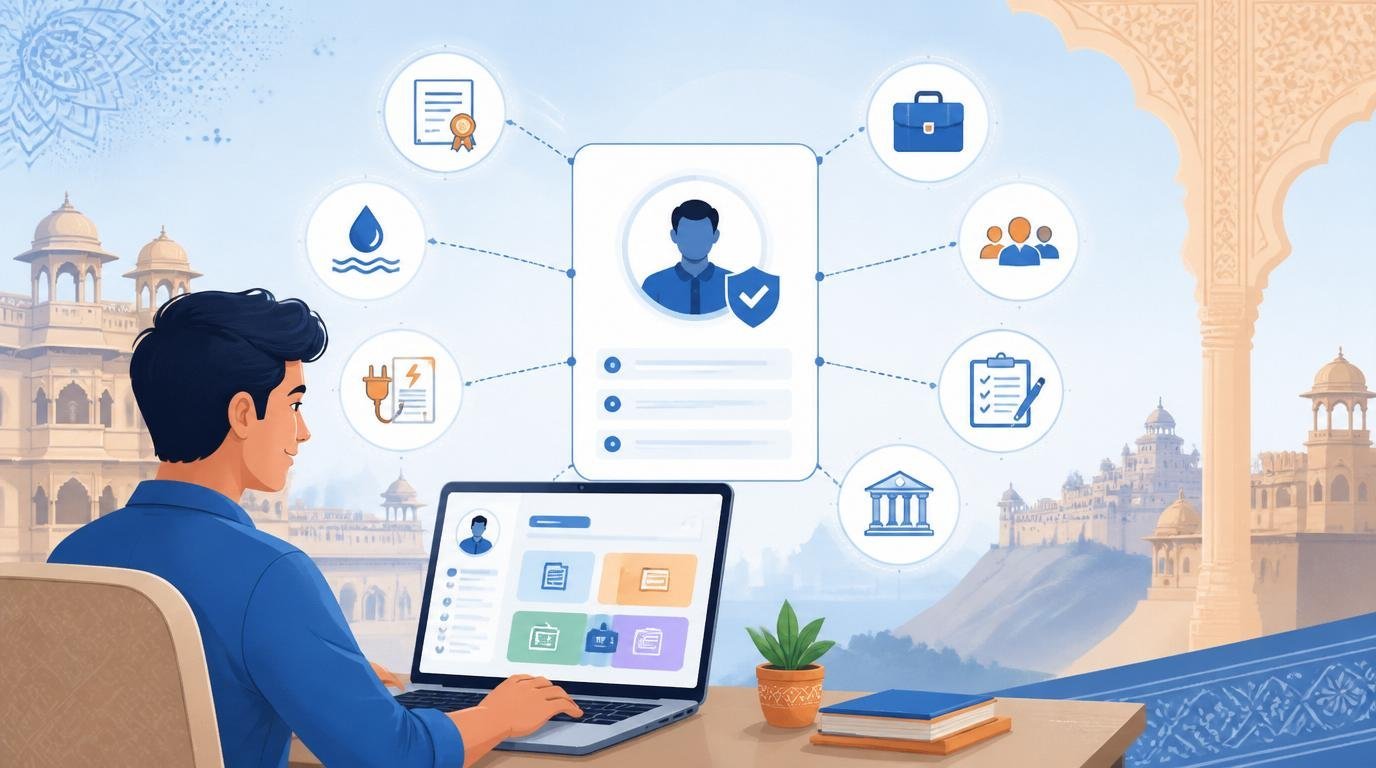
Digital governance has become a major part of modern public administration, especially in regions that are actively moving toward paperless and citizen-friendly systems. In Rajasthan, this transformation is clearly visible through the introduction of a unified digital access system designed to simplify how people interact with government services. Instead of dealing with multiple portals and repeated verification processes, users now experience a more streamlined approach that connects services under a single identity framework.
This shift is not just about technology; it is about changing how people experience governance. But how exactly does this system work, and why has it become so important for both citizens and government employees?
Understanding the Core Idea of Digital Identity Access
The foundation of this system is built on the idea of a single digital identity that allows users to access multiple services without repeatedly signing in or submitting the same details. Traditionally, government services required separate registrations for different departments, which often created confusion and delays.
With a unified approach, users can manage everything from applications to document access through one secure entry point. This reduces administrative barriers and makes public services more accessible to a wider audience.
At the heart of this ecosystem lies SSO ID, which acts as a central authentication mechanism connecting various government departments and services. It simplifies login processes and ensures that users do not have to maintain multiple accounts for different services.
How Citizens Benefit in Real Life Scenarios
For citizens, the most noticeable advantage is convenience. Whether someone wants to apply for a certificate, check application status, or access welfare schemes, everything becomes accessible through a single login experience.
This system removes the frustration of repeated form filling and reduces the chances of errors caused by manual data entry. It also ensures that users can track their requests without visiting government offices physically.
Imagine a situation where a citizen needs multiple government services in a single day. Without a unified system, this would require logging into different platforms. Now, everything is connected, making the process smoother and more efficient.
Improving Government Workflow and Employee Efficiency
While citizens benefit from simplicity, government employees experience improvements in workflow management. Earlier, employees had to switch between multiple systems, verify redundant data, and manage disconnected databases.
Now, the system allows departments to share verified data securely, reducing duplication and improving coordination. This leads to faster processing of applications and fewer administrative delays.
When internal systems are connected, decision-making becomes more informed and efficient. Employees can focus more on service delivery rather than repetitive data handling tasks. This shift significantly improves productivity across departments.
Enhancing Transparency and Public Trust
One of the most important outcomes of digital governance is transparency. People often want clarity about where their applications stand and how long processes will take. A unified system provides real-time updates, allowing users to track progress easily.
This transparency reduces dependency on intermediaries and builds trust between citizens and government institutions. When processes are visible, accountability naturally improves.
Have you ever wondered why delays often create frustration in public services? It is usually the lack of visibility. With better tracking systems, that gap is significantly reduced.
Security and Data Protection in a Unified System
Whenever sensitive personal data is involved, security becomes a top priority. A centralized identity system ensures that user credentials are protected through encryption and multi-layer authentication methods.
Instead of managing multiple weak passwords across different portals, users rely on one secure identity system. This reduces vulnerabilities and strengthens overall data protection.
Government departments also benefit from standardized security protocols, ensuring consistent protection across services.
Accessibility and Ease of Use for Everyone
A major strength of this system is its accessibility. It is designed to be user-friendly so that even individuals with limited digital experience can navigate it without difficulty.
The interface is structured to reduce complexity, allowing users to focus on their tasks rather than struggling with technical challenges. This inclusivity is especially important in regions where digital literacy is still developing.
By simplifying access, the system ensures that more people can benefit from government services, regardless of their technical background.
A Practical Look at System Usage
From a practical standpoint, the system works by linking user profiles with multiple government departments. Once registered, users can log in and access services without creating separate accounts for each department.
For example, a single profile can be used for education services, utility payments, employment registrations, and welfare schemes. This integration reduces time spent on administrative tasks and increases overall efficiency.
The real strength of this approach is that it eliminates repetitive processes and creates a unified digital environment for governance.
Challenges and User Adaptation
Despite its advantages, no system is without challenges. One of the main issues is ensuring that all users are aware of the platform and understand how to use it effectively. Digital literacy remains a barrier for some segments of the population.
There is also the ongoing need to maintain system performance as user traffic increases. Continuous improvements, updates, and support systems are essential to ensure smooth functioning.
However, these challenges are part of any large-scale digital transformation and can be addressed over time with proper planning and awareness campaigns.
The Future of Digital Governance in Rajasthan
The introduction of unified digital access systems marks an important step toward modern governance. As technology continues to evolve, more services are expected to be integrated into this ecosystem.
This will further reduce administrative delays and improve user experience across all sectors. The long-term vision is to create a fully connected digital governance model where services are efficient, transparent, and accessible to everyone.
With continued development, the system has the potential to become even more advanced, incorporating new technologies such as automation and intelligent service routing.
Conclusion
Digital transformation in governance is no longer optional; it is a necessity. Systems like SSO ID are playing a key role in shaping how citizens and government employees interact with public services. By simplifying access, improving transparency, and enhancing efficiency, they are redefining the overall experience of governance.
As adoption grows, the impact will become even more visible in everyday life, making public services faster, more reliable, and easier to access for everyone.